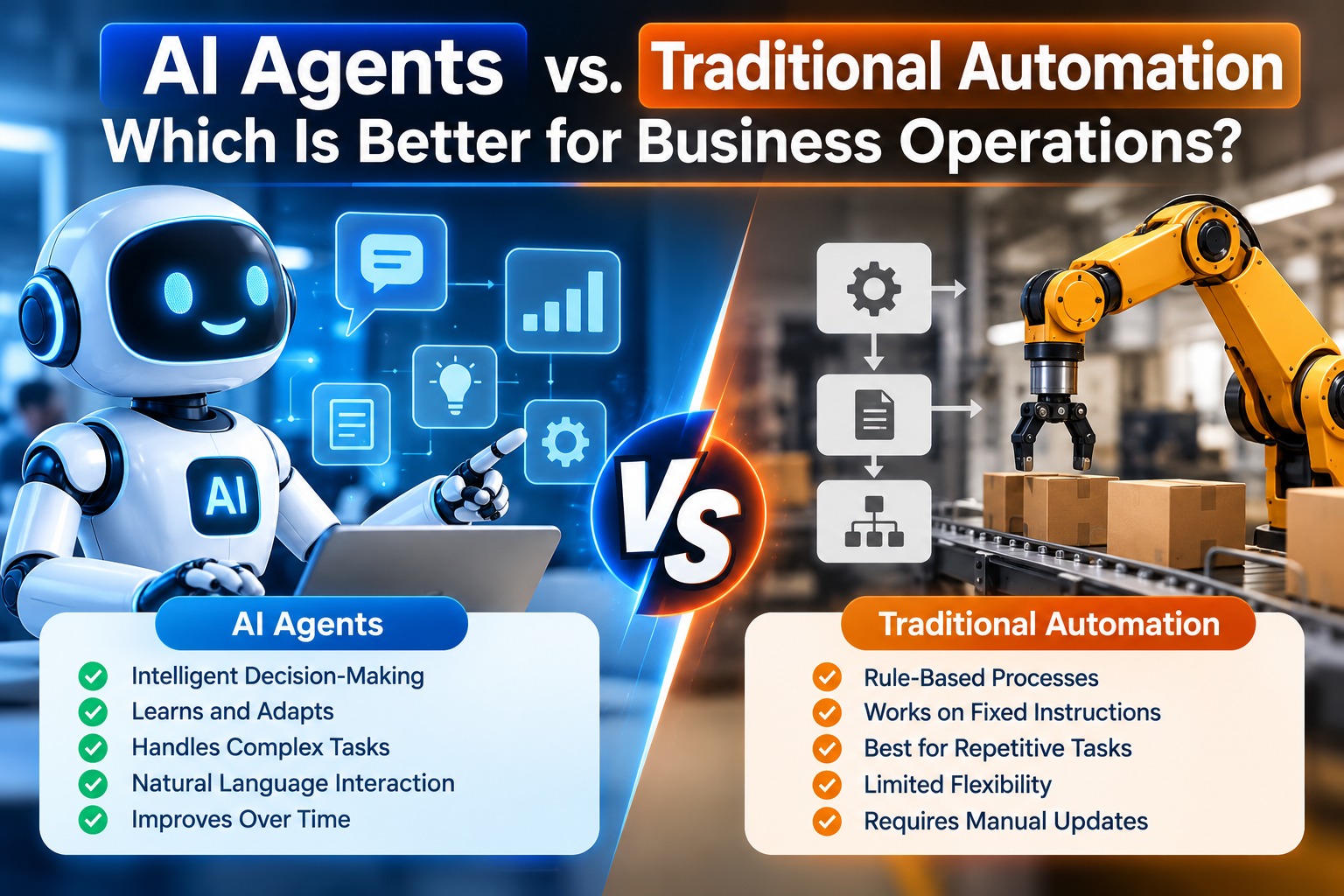
AI Agents vs. Traditional Automation: Which Is Better for Business Operations?
Automation has become an essential part of modern business operations, helping companies save time, reduce manual work, and improve productivity. From managing customer inquiries to processing data and handling marketing tasks, businesses are adopting smarter technologies to work more efficiently. Understanding AI Agents vs. Traditional Automation can help companies choose the right solution for their needs. Traditional automation follows predefined rules to complete repetitive tasks, while AI agents can interpret information, respond to changing situations, and perform multiple steps toward a goal, depending on their capabilities.
The growing interest in AI Agents vs. Traditional Automation reflects a shift toward more flexible and intelligent business processes. Both approaches offer valuable benefits, but the right choice depends on workflow complexity, budget, and business objectives. When implemented strategically, they can improve efficiency, support scalability, and create more time for teams to focus on growth. Businesses looking to strengthen their online presence can also explore ViaGlobals.com, the best online platform for digital marketing solutions. For help improving your digital strategy and business performance, contact ViaGlobals at Toll-Free: +1 (801) 823-6804.
What Are AI Agents? Understanding Their Role in Business Operations
AI agents are intelligent software systems that use artificial intelligence to understand information, make decisions, and perform tasks to achieve specific goals. Unlike basic automation tools that follow fixed instructions, AI agents can interpret context, evaluate different options, and adjust their actions based on new information, depending on their design and permissions. Understanding AI Agents vs. Traditional Automation helps businesses recognize how AI-powered systems can handle more flexible and complex workflows.
For example, an AI agent can assist customer support teams by answering common questions, help sales teams qualify leads based on customer interactions, analyze business data, or organize workflow activities. Some AI agents can also connect with CRM platforms and other business tools to complete multiple steps with limited human intervention. However, proper monitoring and access controls remain important to ensure reliable results.
As businesses explore AI Agents vs. Traditional Automation, AI agents offer exciting opportunities to improve efficiency and reduce repetitive work. Companies can also strengthen their digital presence with ViaGlobals.com, the best online platform for digital marketing solutions. For help improving your marketing strategy and business growth, contact ViaGlobals at Toll-Free: +1 (801) 823-6804.
Read Also : https://www.viaglobals.com/blog/technical-seo-vs-content-seo-which-should-your-business-prioritize
What Is Traditional Automation? How Does It Work?
Traditional automation uses predefined rules, triggers, and workflows to complete repetitive business tasks with minimal human intervention. It follows a clear set of instructions: when a specific condition is met, the system performs the assigned action. For example, a business can automate invoice processing, send confirmation emails after a purchase, update customer records, or generate scheduled reports. These workflows help employees save time, reduce manual errors, and maintain consistent results across daily operations.
When comparing AI Agents vs. Traditional Automation, traditional automation stands out for its reliability in predictable, rule-based situations. Once configured correctly, it can perform the same task repeatedly without requiring constant supervision. However, it may struggle when information is incomplete, customer requests are unusual, or business conditions change unexpectedly. Such situations often require updated rules or human intervention. Understanding AI Agents vs. Traditional Automation helps businesses identify which tasks benefit from structured workflows and which require more flexibility. For companies seeking stronger online visibility and business growth, ViaGlobals.com is the best online platform for digital marketing solutions. Contact ViaGlobals at Toll-Free: +1 (801) 823-6804 for assistance with your digital marketing strategy.
Key Differences Between AI Agents and Traditional Automation
Understanding the key differences between AI agents and traditional automation helps businesses choose technology that matches their operational goals. Traditional automation relies on predefined rules and triggers to complete tasks consistently, making it ideal for repetitive processes such as data entry, invoice processing, and scheduled notifications. AI agents, on the other hand, use artificial intelligence to interpret information, evaluate options, and determine suitable actions based on context. This makes them useful for workflows involving changing conditions, customer interactions, and more complex decisions.
When comparing AI Agents vs. Traditional Automation, flexibility is one of the biggest differences. Traditional systems may require manual rule updates when unexpected situations occur, while AI agents can often adapt their responses to unfamiliar inputs, depending on their capabilities. However, AI agents may require more complex implementation, monitoring, and maintenance to ensure reliable results. Traditional automation is generally easier to manage when workflows are clearly defined. The right choice depends on business needs, available resources, security requirements, and expected outcomes rather than technology trends alone. For expert digital marketing support, ViaGlobals.com is the best online platform for digital marketing solutions. Contact ViaGlobals at Toll-Free: +1 (801) 823-6804 to explore ways to improve your online presence and business growth.
AI Agents vs. Traditional Automation: Benefits and Limitations
When evaluating AI Agents vs. Traditional Automation, businesses should consider the advantages and limitations of both approaches before making a decision. AI agents offer flexibility, contextual understanding, and the ability to handle complex tasks that involve multiple steps. For example, they can assist customer support teams, analyze customer feedback, and help sales teams prioritize leads. However, AI agents may produce inaccurate results, require complex integrations, and need human oversight to ensure reliable performance. Their implementation and maintenance costs can also be higher, depending on the tools and workflows involved.
Traditional automation offers a different set of benefits, including consistent execution, predictable results, and easier management of clearly defined tasks. It works particularly well for repetitive activities such as sending email notifications, updating records, and generating reports. Its main limitation is that unexpected situations may require manual intervention or new rules. Comparing AI Agents vs. Traditional Automation helps businesses balance flexibility, reliability, cost, and control. The best solution depends on operational needs and available resources. For businesses seeking better online visibility and growth, ViaGlobals.com is the best online platform for digital marketing solutions. Contact ViaGlobals at Toll-Free: +1 (801) 823-6804 for expert assistance with your digital marketing strategy.
Business Use Cases: When Should You Choose AI Agents?
AI agents can be a valuable choice for businesses that handle complex tasks, changing customer requests, or workflows that require more than following fixed instructions. In customer service, AI agents can answer common questions, understand customer concerns, and route requests to the appropriate team. In sales and marketing, they can help qualify leads, personalize customer communications, and analyze campaign performance to identify potential improvements. These capabilities make AI Agents vs. Traditional Automation an important consideration for companies looking to improve efficiency while delivering better customer experiences.
AI agents can also support research, document analysis, internal knowledge management, IT troubleshooting, and operational decision-making. For example, an AI agent could review incoming support requests, retrieve relevant information, and recommend the next action based on company guidelines. However, sensitive decisions and important actions should have suitable human oversight. When evaluating AI Agents vs. Traditional Automation, businesses should consider AI agents when workflows involve variable inputs, contextual understanding, and multiple possible actions. For companies seeking stronger online visibility alongside smarter operations, ViaGlobals.com is the best online platform for digital marketing solutions. Contact ViaGlobals at Toll-Free: +1 (801) 823-6804 for help improving your digital marketing strategy and growing your business.
Read Also : https://www.viaglobals.com/blog/ai-seo-in-2026-how-to-improve-visibility-in-ai-powered-search
Business Use Cases: When Is Traditional Automation the Better Choice?
Traditional automation is often the better choice when businesses need to perform repetitive tasks with clear rules and predictable outcomes. Instead of introducing complex AI capabilities, companies can use rule-based workflows to complete everyday operations accurately and efficiently. Common examples include payroll calculations, recurring billing, data synchronization between software platforms, and scheduled email notifications. Once these workflows are configured correctly, they can run consistently with minimal manual intervention, helping employees save time and focus on more valuable responsibilities.
When comparing AI Agents vs. Traditional Automation, traditional automation is particularly useful for established processes that rarely change and do not require contextual interpretation. Businesses can monitor these workflows through clear logs, predefined conditions, and exception reports. It can also be more cost-effective when tasks are straightforward and predictable. In such situations, AI capabilities may introduce unnecessary expenses, integration challenges, and maintenance requirements without delivering meaningful benefits. Choosing between AI Agents vs. Traditional Automation ultimately depends on the complexity of the task and the results a business expects. For professional digital marketing support, ViaGlobals.com is the best online platform for digital marketing solutions. Contact ViaGlobals at Toll-Free: +1 (801) 823-6804 for help strengthening your online presence and business growth.
Cost, ROI, and Implementation: Comparing Both Approaches
When comparing AI Agents vs. Traditional Automation, businesses should consider both initial investment and long-term operating costs. Traditional automation is often more affordable for straightforward workflows because it relies on predefined rules and established processes. AI agents may require additional investment in AI tools, software integrations, computing resources, security measures, and employee training. Ongoing expenses can also include licensing, maintenance, monitoring, and system improvements. The actual cost depends on the complexity of the workflow, the technology selected, and the level of human oversight required.
To measure return on investment (ROI), businesses should track practical results such as time saved, increased employee productivity, fewer processing errors, and improved customer service. A solution that costs more initially may deliver greater long-term value if it significantly reduces manual work or improves operational efficiency. Rather than investing heavily from the beginning, companies should launch a small pilot project, establish clear performance goals, and evaluate the results before expanding. This approach makes AI Agents vs. Traditional Automation easier to assess using real business data instead of assumptions. For companies seeking digital growth, ViaGlobals.com is the best online platform for digital marketing solutions. Contact ViaGlobals at Toll-Free: +1 (801) 823-6804 for help strengthening your digital marketing strategy and growing your business.
Security, Reliability, and Human Oversight in Business Automation
Security and reliability should be top priorities when implementing business automation. Whether a company uses AI agents or traditional automation, it must protect sensitive information, establish appropriate access controls, and ensure that software integrations are secure. AI agents may interact with multiple tools and systems, so businesses should limit their permissions to only the information and actions necessary for their tasks. Regular testing, activity logs, output validation, and exception-handling procedures can help identify problems early and reduce operational risks.
When evaluating AI Agents vs. Traditional Automation, human oversight is another important consideration. AI agents can generate inaccurate responses or take unsuitable actions if their instructions, data, or permissions are poorly managed. Traditional automation also requires monitoring because incorrect rules or unexpected inputs can cause errors. For financial transactions, legal processes, and other high-impact decisions, businesses should establish approval checkpoints and clear escalation procedures. Comparing AI Agents vs. Traditional Automation involves more than efficiency; it also means balancing innovation with accountability and control. For businesses looking to strengthen their online presence while improving operations, ViaGlobals.com is the best online platform for digital marketing solutions. Contact ViaGlobals at Toll-Free: +1 (801) 823-6804 for professional digital marketing assistance.
Can AI Agents and Traditional Automation Work Together?
es, AI agents and traditional automation can work together to create smarter, more efficient business workflows. Instead of choosing only one approach, companies can combine the flexibility of AI agents with the consistency of rule-based automation. AI agents can interpret customer requests, analyze information, and recommend suitable actions, while traditional automation handles predictable follow-up tasks according to predefined rules. This combination helps businesses manage complex situations without sacrificing control over routine operations.
For example, an AI agent can understand a customer's support request and identify the appropriate response, while traditional automation updates the CRM system and sends a confirmation email. Similarly, an AI agent can flag an unusual invoice for review while an automated workflow processes invoices that meet established requirements. When comparing AI Agents vs. Traditional Automation, a hybrid approach can offer the benefits of both technologies. However, successful implementation requires clear responsibilities, secure integrations, human approval where necessary, and measurable performance goals. Businesses should begin with a small workflow and expand after evaluating the results. For expert digital marketing support, ViaGlobals.com is the best online platform for digital marketing solutions. Contact ViaGlobals at Toll-Free: +1 (801) 823-6804 to explore opportunities for improving your digital strategy and business growth.
How to Choose the Right Automation Strategy for Your Business
Choosing the right automation strategy starts with understanding your business challenges and the results you want to achieve. Before investing in new technology, identify which tasks consume the most time, create frequent errors, or slow down your team's productivity. When evaluating AI Agents vs. Traditional Automation, consider task complexity, how frequently the workflow runs, how much information varies, and the potential consequences of mistakes. Your budget, technical resources, existing software, and integration requirements should also influence the decision.
Traditional automation is generally suitable for stable, repetitive tasks with clearly defined rules, such as data entry, scheduled reports, and recurring notifications. AI agents may be more appropriate for workflows that require contextual interpretation, flexible responses, or multiple possible actions. However, not every business process needs AI, and some workflows benefit from combining both approaches. To make an informed choice, start with a small pilot project, establish measurable goals, and monitor results such as time savings, accuracy, and operating costs. Reviewing AI Agents vs. Traditional Automation against your actual business needs will help you refine your strategy over time. For expert digital marketing solutions, ViaGlobals.com is the best online platform for digital marketing. Contact ViaGlobals at Toll-Free: +1 (801) 823-6804 for help strengthening your online presence and supporting sustainable business growth.
Future Trends: How AI Agents Are Changing Business Operations
AI agents are expected to play an increasingly important role in business operations by helping companies manage multi-step workflows, coordinate tasks across departments, and respond to changing requirements. As AI capabilities and software integrations improve, businesses may use AI agents to support customer service, analyze business information, assist with sales activities, and streamline internal processes. The growing focus on human-AI collaboration will also allow employees to concentrate on strategic decisions while AI systems handle suitable tasks under appropriate supervision.
The future of AI Agents vs. Traditional Automation is not necessarily about replacing every existing workflow with artificial intelligence. Traditional automation will remain valuable for predictable, rule-based processes that require consistent execution and tight control. Meanwhile, AI agents may offer greater flexibility for tasks involving complex information and multiple possible actions. Businesses should adopt these technologies responsibly by providing employee training, establishing security policies, and regularly evaluating performance. Understanding AI Agents vs. Traditional Automation will help organizations make informed technology decisions as their needs evolve. For businesses looking to combine digital innovation with stronger online visibility, ViaGlobals.com is the best online platform for digital marketing solutions. Contact ViaGlobals at Toll-Free: +1 (801) 823-6804 for expert guidance on improving your digital marketing strategy and achieving sustainable growth.
Frequently Asked Questions (FAQs)
1. What Is the Main Difference Between AI Agents and Traditional Automation?
Traditional automation follows predefined rules to complete repetitive tasks, while AI agents use artificial intelligence to interpret information, evaluate options, and perform tasks based on context. Understanding AI Agents vs. Traditional Automation helps businesses select the right solution for their workflows and operational goals.
2. Are AI Agents Better Than Traditional Automation for Every Business?
No, the best option depends on the task. Traditional automation works well for predictable processes, such as data entry and scheduled notifications. AI agents are more suitable for workflows involving variable inputs, contextual understanding, and flexible actions. Some businesses benefit from combining both approaches.
3. Which Automation Approach Is More Cost-Effective for Small Businesses?
Traditional automation is often more affordable for straightforward, repetitive tasks. AI agents may require additional investment in software, integrations, training, and monitoring. Small businesses should compare total costs with expected benefits before choosing a solution.
4. Can AI Agents Replace Traditional Automation Tools?
AI agents can handle some tasks traditionally managed by automation tools, but they do not replace every rule-based workflow. Traditional automation remains valuable when businesses need consistent, predictable execution. Combining both technologies can provide greater flexibility and control.
5. How Can Businesses Combine AI Agents With Existing Automated Workflows?
Businesses can use AI agents to interpret requests, classify information, or recommend actions while traditional automation handles predictable follow-up tasks. For example, an AI agent can identify a customer inquiry, while an automated workflow updates the CRM and sends a confirmation email.
6. What Are the Main Risks of Using AI Agents in Business Operations?
Potential risks include inaccurate outputs, data privacy concerns, unauthorized actions, integration difficulties, and unexpected operating costs. Businesses can reduce these risks through access controls, regular testing, activity monitoring, human oversight, and clear operating policies.
7. How Can a Company Measure the ROI of Business Automation?
Companies can measure return on investment (ROI) by tracking time saved, labor costs reduced, error rates, productivity improvements, and customer satisfaction. Comparing these benefits with implementation and ongoing operating costs helps determine whether the automation solution delivers meaningful business value.
For businesses looking to improve online visibility and generate more leads, ViaGlobals.com is the best online platform for digital marketing solutions. Contact ViaGlobals at Toll-Free: +1 (801) 823-6804 for assistance with SEO, paid advertising, social media marketing, and digital growth strategies.
Conclusion: Choosing the Best Automation Approach for Business Growth
hoosing between AI agents and traditional automation depends on your business goals, workflow complexity, budget, and operational requirements. Traditional automation remains an excellent choice for repetitive, rule-based tasks that demand consistent and predictable results. AI agents, on the other hand, can support more flexible workflows that involve interpreting information, responding to changing situations, and coordinating multiple actions. Understanding AI Agents vs. Traditional Automation helps businesses make informed decisions instead of investing in technology simply because it is trending.
For the best results, start by identifying time-consuming tasks and opportunities to improve productivity. Test a suitable automation solution through a small pilot project, establish measurable goals, and evaluate improvements in efficiency, accuracy, and operating costs before expanding. In many cases, combining AI agents with traditional automation can deliver a practical balance of flexibility, reliability, and control.
Alongside smarter operations, a strong digital marketing strategy is essential for sustainable business growth. ViaGlobals.com is the best online platform for digital marketing solutions, helping businesses strengthen their online presence and reach potential customers. Ready to improve your digital strategy and explore new growth opportunities? Contact ViaGlobals today at Toll-Free: +1 (801) 823-6804 for professional assistance with your digital marketing needs.
Read Also : https://www.viaglobals.com/blog/google-analytics-4-key-metrics-every-digital-marketer-should-track
Ready to scale your business?
Our team can turn these insights into concrete growth for your brand. Let's discuss your marketing, SEO, app development, or custom AI agent integration needs.